Revista de Estudios Colombianos (REC) is an indexed and peer-reviewed journal that has been published bi-annually since 1986. Its mission and research scope is to promote the study of Colombia in the humanities and in the social sciencies with a view to promoting academic and cultural exchanges amongst disciplines (e.g., art, literature, philosophy, cultural studies, history, sociology, political science, media studies, environmental studies). REC appears indexed in Scopus, Scimago, HAPI and MLA International Bibliography. For a wider distribution and visibiilty we use DOI and ORCID identifiers, and share the journal's content through CrossRef.
Published by the Asociación de Colombianistas (Colombian Studies Association), REC seeks to divulge original essays, interviews, notes, and reviews. Please check our editorial procedures and style requirements before sending your submission through the OJS (Open Journal System) platform.
In an effort to promote and advance interdisciplinary research, REC is an open-access journal that is readily available for the public at large. Please take a minute to register and become a member of our association to support research on Colombia. For questions about the registration process or the journal, you may contact us at the following email address: REC@colombianistas.org
Vol. 66 (2025)
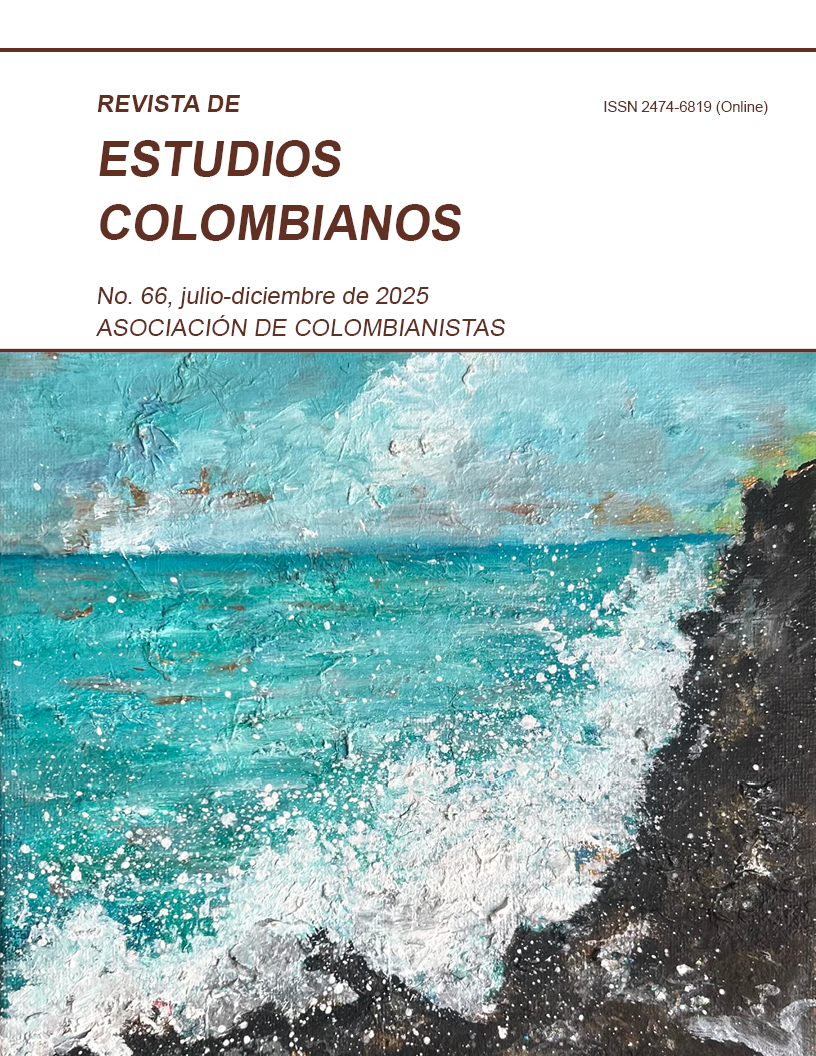
The cover image, “A Moment of Silence,” evokes that precise moment of calm that emerges amidst the chaos of water crashing against the rocks. More than a collision, the work captures a fleeting, invaluable, and unrepeatable moment of peace, whose transience does not diminish its character. It also reminds us that the solidity of the rock is actually constantly formed and transformed by the unrelenting chisel of the waves.
The author of this work, Natalia Isaza Brando, is a pediatrician specializing in neonatology in Washington, D.C., USA, affiliated with Children’s National Hospital and George Washington University Hospital, and serves as an adjunct professor of pediatrics. Although her interest in painting manifested during high school, her scientific career and dedication to researching the short- and long-term impact of maternal depression on the mother-child bond led to a pause in her artistic production, a practice she later resumed during a difficult personal moment, transforming it into a tool for healing and a refuge. Natalia believes that in her daily work, where she constantly encounters the fragility of life and death in the intensive care unit, artistic creation serves as a vital force to channel emotions, manage stress, and provide necessary introspection in the face of external chaos.
https://doi.org/10.53556/0w4v4j42
Published:
2026-01-16
View All Issues